
The Protein Number Was Never the Hard Part
A new Yale-led study finds GLP-1 drugs may reprogram metabolism rather than just suppress appetite, and separate research shows most people on them fall short on protein anyway. Mr BITE's own protein formula already lands in the right range. Our safety logic guarantees the people who disclose a GLP-1 never see it.
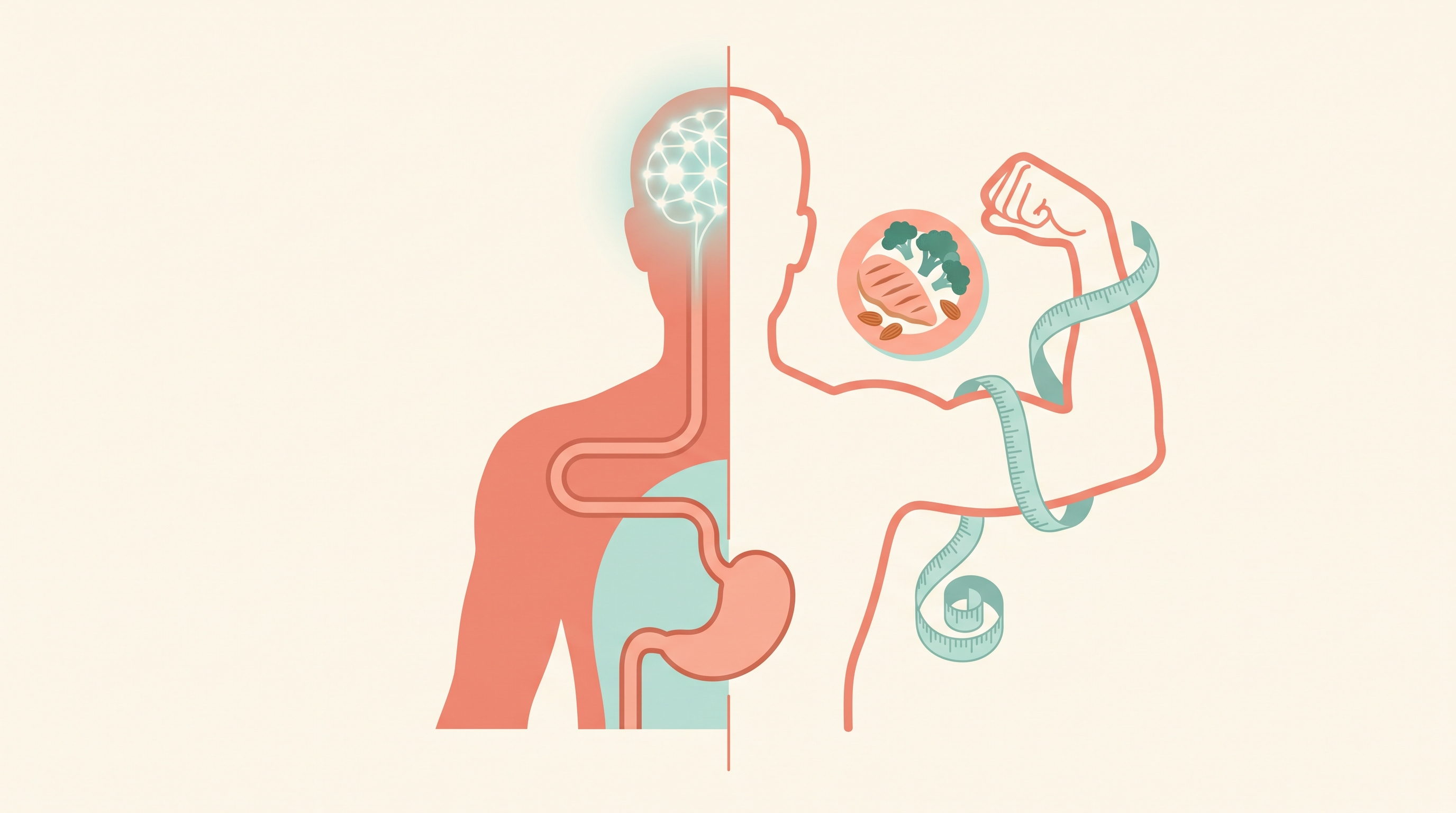
A study out of Yale this month complicates something a lot of us, myself included, had quietly filed as settled science. The standard story on drugs like Ozempic and Wegovy is that they work by turning down hunger: block the signal, eat less, lose weight. Researchers there ran an experiment on mice that undercuts the “just turns down hunger” part of that story. AgRP neurons, the brain cells best known for driving hunger, were expected to work against these drugs, fighting to restore appetite the way they do during ordinary dieting. Instead, using genetic tools to selectively silence those neurons, the team found that mice lost the ability to sustain fat loss on semaglutide once the neurons were gone, even though the mice were still eating less. Electron microscopy and electrophysiology showed the neurons being activated, not shut down, during treatment. The drug isn’t just quieting hunger. It appears to be recruiting the hunger circuit to help hold the fat loss in place.
That’s a mouse study, and the authors are careful about what it doesn’t yet show in people. But it lands next to a much more practical finding that’s been sitting in the literature for a year and hasn’t gotten nearly the same attention: a Journal of the International Society of Sports Nutrition study that measured actual protein intake in sixty adults on a GLP-1 receptor agonist. Only 43% were hitting the conservative floor of 1.2 grams per kilogram that clinicians use to protect muscle during weight loss. Just 10% reached 1.6 g/kg, the number most muscle-preservation guidance actually recommends. Appetite suppression doesn’t stop at the food someone wanted to skip. It cuts into the protein they needed too, and the mechanism Yale just described, a drug that’s actively reshaping metabolic behavior rather than politely dialing down cravings, is exactly the kind of thing that would make “just eat what you can” bad advice for this specific population.
So I went and checked what Mr BITE actually does with that. Our automatic protein target isn’t flat. It scales with goal and pace: someone in a fat-loss deficit lands between 1.8 and 2.0 grams per kilogram of bodyweight, comfortably above the 1.2 to 1.6 g/kg range the muscle-preservation research calls for. On paper, our number was never the problem. If anything it’s generous.
Here’s the part that stopped me. During onboarding, Mr BITE asks a genuinely good safety question: any reason coaching should stay extra gentle, with an option for “medical condition or medication affects diet/weight.” Anyone honest enough to check that box, which is exactly the box a GLP-1 user should check, gets routed into what our code calls clinician_required mode. And in that mode, Mr BITE doesn’t just soften its tone. It refuses to calculate or save any calorie or macro target at all, protein included, and tells the person to work with a licensed clinician instead. The design isn’t wrong to exist. Handing out weight-loss macro targets to someone with a doctor-managed condition, unsupervised, is a real risk worth being conservative about. But the logic doesn’t distinguish “don’t set this person’s calorie deficit” from “don’t tell this person what a reasonable protein number even looks like,” and it collapses both into the same refusal. The exact users the research says are most likely to be running short on protein, quietly losing muscle they didn’t mean to lose, are the ones our own safety code guarantees will never see a protein number from us at all.
I don’t have a clean fix to announce here, and I’d rather say that plainly than pretend otherwise. A protein target for muscle maintenance and a calorie deficit for weight loss aren’t the same kind of number, one is closer to a floor than a lever, but building a system that can offer one without quietly implying the other is exactly the kind of nuance that’s easy to state and harder to get right in a chat interface. What I do know is that the gap isn’t in our math. It’s in the one place our math never gets to run.
BITE of the Week: One Import, Three Root Causes

No version bump this week. 1.10.0, cut on August 22nd with the write-receipt guard and recipe version families, is still the build working through app store review; 1.9.0 remains what’s live on both stores. The three fixes below land on top of it for whenever the next build ships.
All three trace back to one real production conversation on August 22nd, job 6ec23471: a user pasted an Instagram reel link, Mr Bite replied “it’ll land in My Recipes in about a minute,” and then nothing did. The import failed ninety seconds later with no explanation, and the user was left staring at a promise that never resolved.
The first bug was Instagram itself. When our crawler requested the reel, Instagram served back a technically-successful response with no actual content, no caption, no og: tags, nothing. The old fallback logic only reached for a reader proxy when a fetch returned zero bytes outright, and it explicitly excluded Instagram on the assumption that the proxy would hit the same login wall the direct fetch did. That assumption was wrong: tested against the exact reel that killed job 6ec23471, the proxy returned the full caption, ingredient list, and macros. The fallback now fires whenever a direct read comes back with nothing usable, caption, page text, or structured data, and Instagram is no longer excluded.
The second bug was the timeout hiding the first one. The transcript service we call had a 90-second ceiling, and it turns out that ceiling was pure cost with no benefit: across every import through August 22nd, the 36 imports that actually succeeded had a median wait of 8 seconds and a max of 33, while every failure returned no HTTP status at all and simply ran the clock out to 90. The timeout was never saving a slow success. It was just making every failure take as long as possible while the coach had already told the user “about a minute.” It’s cut to 45 seconds, with the measurement pinned in a comment next to the constant.
The third bug was the silence itself. There’s supposed to be a failure notice that fires when an import doesn’t pan out, so the user at least learns it didn’t work instead of wondering why nothing showed up. Both chat-based import paths called the underlying tool without a conversationId, and the notice code returns early with nothing to thread a reply through when that’s missing. It had been structurally incapable of reaching anyone since the day it shipped. conversationId now flows through the import path and through every tool call in the main loop, so any future tool whose work outlives the turn keeps a way back to the user.
Three Quick Bites

-
A Yale-led study in mice found that GLP-1 drugs like semaglutide may actively recruit hunger neurons to help sustain fat loss, rather than simply suppressing them. Researchers used genetic tools to silence AgRP neurons, cells best known for driving hunger, and found mice lost the ability to sustain weight loss on the drug once those neurons were gone, even though they were still eating less. Electron microscopy and electrophysiology showed the neurons being activated rather than quieted during treatment. It’s an animal study, published in PNAS, and the authors are explicit that it needs confirmation in people before it changes clinical thinking. It’s the study behind the essay above. ScienceDaily
-
UC Berkeley researchers identified a compound that helped obese mice burn fat and improve insulin sensitivity without suppressing appetite or losing muscle mass. The molecule, called TOFA, works by boosting cellular energy expenditure rather than cutting food intake: treated mice lost fat, improved glucose control, and showed no significant loss of lean muscle, with no change in how much they ate. It’s preclinical, mouse-only, and the researchers have founded a company to pursue human testing, which hasn’t started. ScienceDaily
-
HHS and the FDA published a proposed rule that would make GRAS safety notifications mandatory for the first time since 1958. Under current rules, a manufacturer can decide an ingredient is “generally recognized as safe” and add it to the food supply without ever telling the FDA. The proposed rule, published in the Federal Register on August 11th under docket FDA-2025-N-3262, would close that loophole by requiring notification. It carries no restriction on any specific ingredient by itself, and the public comment period runs through December 9th. FDA.gov
Tool of the Week: Examine.com

Since this issue is about a population, not a single number, this week’s pick is the resource I actually reach for when a specific supplement, drug interaction, or nutrient question needs a real answer instead of a forum thread. Examine.com is an independent research summary site that reads the primary literature, a randomised trial, a meta-analysis, a mechanism study like the AgRP one above, and distills what it actually supports, with confidence gradings and citations back to the original paper, rather than someone’s opinion of it. For readers: the free database covers supplements, foods, and health topics with a plain-language summary of what the evidence says and how strong it is. For builders: it’s a useful discipline to borrow directly, cite the primary source, grade your confidence, and say clearly when something is a mouse study and not a clinical one, which is exactly the distinction this issue leaned on twice. examine.com. Free tier available, no signup required for most content.
Thanks for reading. If you’d rather your coach told you when it doesn’t have an answer for you specifically, Mr BITE is free on iOS and Android.
Michael, building Mr BITE